
KIDNEY HEALTH DISPARITIES
Chronic kidney disease occurs when damage to the organs builds up over time – frequently caused by underlying disease such as high blood pressure, cardiovascular disease, and diabetes. This damage causes kidneys to struggle to filter waste and fluid from the bloodstream.
Kidney disease disproportionately affects communities of color – rates of kidney failure are nearly four times as high for Black Americans in comparison to white Americans – primarily due to higher rates of underlying disease in the population.

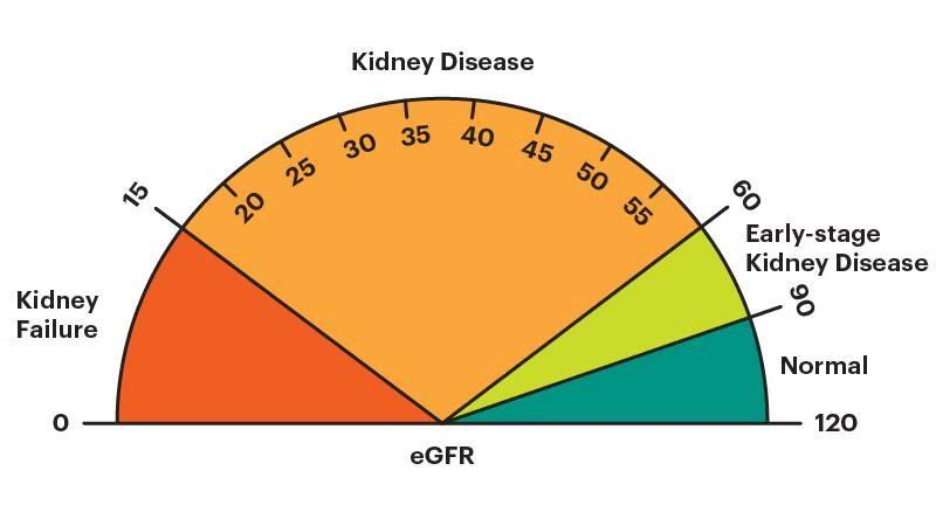
While Black Americans make up less than 14% of the population, Black patients make up over 35% of dialysis patients. Dialysis is used for end-stage kidney disease, when eGFR is below 15, and kidneys are failing — it keeps patients alive by helping to filter waste and fluid. Dialysis cannot cure kidney disease; patients will be on dialysis until they die or receive a transplant.

Kidney transplants are the only cure for failing kidneys, but despite higher rates of diagnosed disease, the average wait time for Black patients to receive a kidney transplant is a year longer than white patients, who already have a typical wait time of 3 to 5 years.
“Black patients are less likely to receive a transplant evaluation, have less access to the waitlist, spend longer on the transplant waitlist, are less likely to survive on the waitlist, and have lower rates of graft survival post-transplant.”
- The National Kidney Foundation
IMPACT OF THE ALGORITHM
How does the algorithm work?
Measuring eGFR assists in the diagnosis and staging of kidney disease and helps determine what interventions are needed. Normal kidney function is associated with an eGFR greater than or equal to 90 ml/min/1.73 m^2. Values below this threshold may be associated with the stages of chronic kidney disease (CKD). The lower the eGFR score, the worse the kidney function and the higher the risk of kidney disease progression.
How does the EGFR algorithm contribute to these disparities?
The inclusion of race in eGFR calculations provides a 16% higher eGFR for Black patients, leading to a less severe kidney disease diagnosis and resulting in delays in diagnosis and treatment (e.g., dialysis and kidney transplant).
Excluding race from the algorithm results in an earlier, more accurate CKD diagnosis, staging, and treatment for Black patients.
What is the current eGFR algorithm?
The National Kidney Foundation and American Society of Nephrology task force recommended the immediate implementation of the race-neutral formula to all laboratories and healthcare systems nationwide in 2021.
The current algorithm does not use race in the score.
Click here for more information – and to see how the calculators work.
COALITION IMPACT
All health systems participating in the Coalition to Eliminate Race-Based Medicine have updated their eGFR equation to remove race as a variable. As a result of this change in September of 2024:

Due to the changes made to the eGFR algorithm, patients will appropriately be placed on the kidney transplant list moving forward, leading to more equitable care and recovery.